
Site 11: Zanzibar

On Monday, March 18th, we departed from Bagamoyo to head to our last and long-awaited stop: Zanzibar! During travel day, we got a glimpse of Dar-es-Salaam, where we boarded the ferry for Unguja, the main island of the Zanzibar archipelago. While some slept throughout the whole two-hour ferry ride, others enjoyed the view on the lower terrace, wind in their hair, facing the sea. We arrived in the evening, exhausted but happy, at Manch Lodge, which would be our home for the last week of the program.

The next morning, we enjoyed a tour of Stone Town, led by local guides. While strolling through the narrow streets, we got to admire the mixed Arabic, Persian, Indian, European and African influences present on the island, thanks to its rich history. We learned how to differentiate Indian from Arabic doors, and wandered through the fish market and the colorful spice market of Zanzibar city. We got to see the house of the famous Freddie Mercury, which was very exciting for all the Queen fans in our group. We also wandered to the Jaws corner (named after a mural of the movie Jaws on a building), where local men gather to drink coffee and debate politics

Picture 1: One of the many beautiful doors in Stone town.

On Wednesday, we went to a spice farm in Dole, half an hour away from Stone town. There, we got to discover how many spices and fruits are cultivated: jackfruit, breadfruit, cinnamon, cardamom, black pepper, vanilla, star fruit, passion fruit, etc. We even got a demonstration of how to harvest coconuts from the tree and got to drink fresh coconut juice, while getting palm leave crowns put on our heads. We then had a delicious lunch, made with all the spices we saw and tasted some local pineapple, grapefruit, and different kinds of banana. 
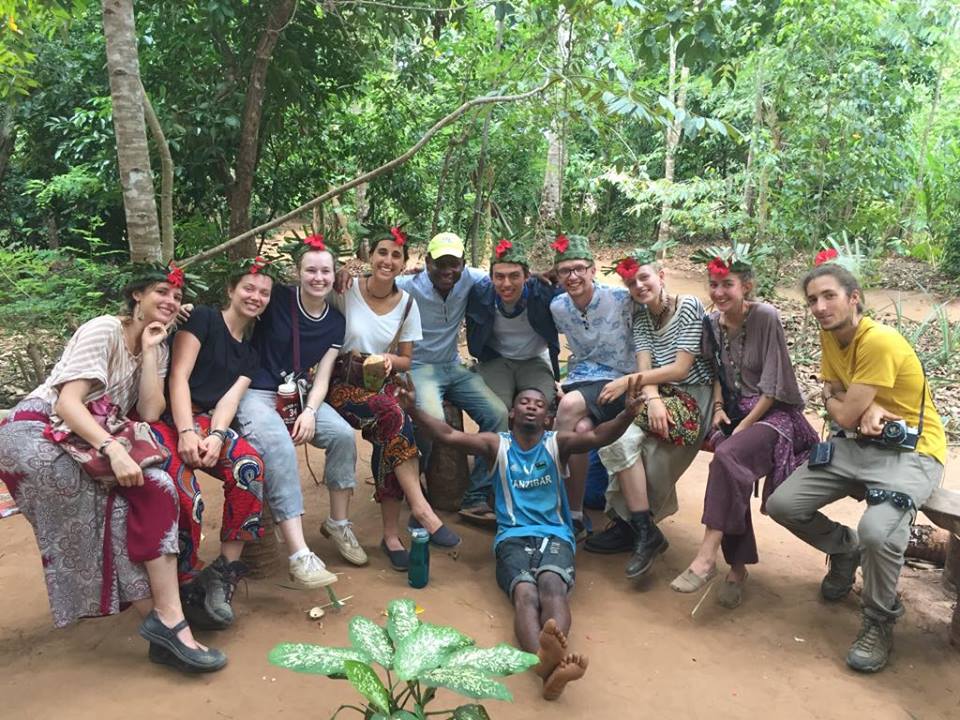
Picture 2: The students at the spice farm, just before learning how to climb a coconut tree with Mr. Butterfly. You can notice colourful spices on some of the student faces … and their amazing hats! From left to right: Maia, Hannah, Natalie, Cailin, our guide, Joseph, Ethan, Thalia, Emily, River and Mr. Butterfly!

On Friday, we went snorkeling two hours away from Stone Town, in an absolutely heavenly spot! We dove into the perfectly turquoise water to look at an array of fish, coral, starfish, and sea cucumbers. We also had a few encounters with jellyfish, but lived to tell about them. The day ended with a fresh fish lunch and sea turtle viewing. 
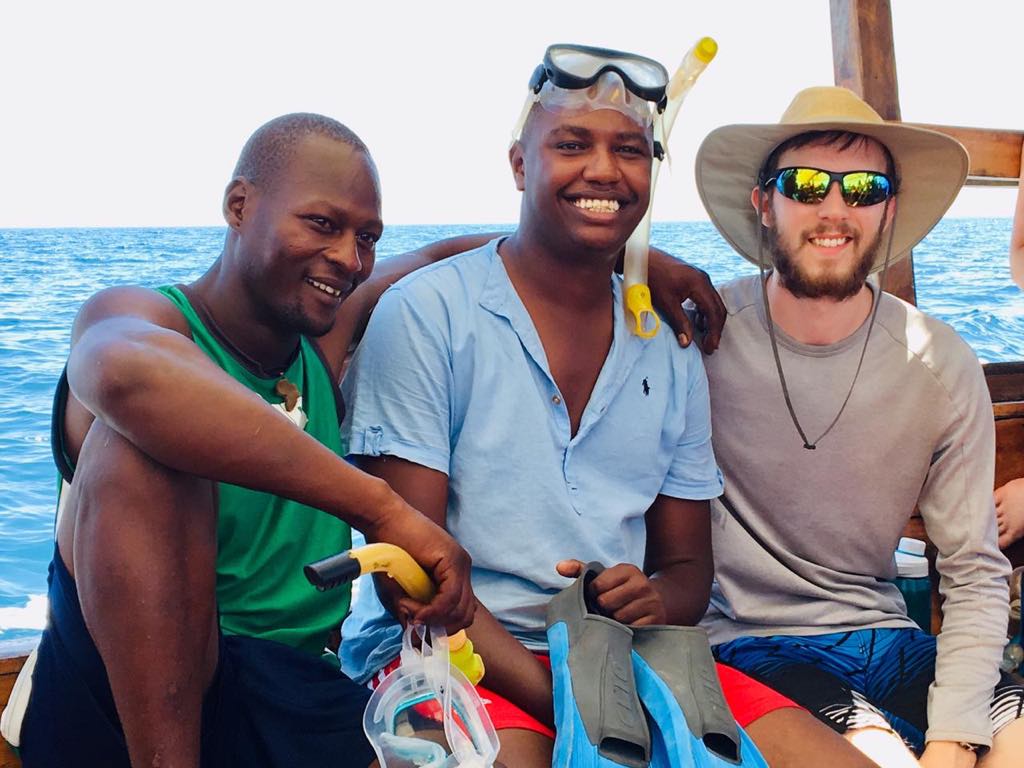
Picture 3: Freddie, Martin and Julien are ready for some snorkeling !
Picture 4: Lina and Emily feeding the sea turtles.

The rest of our time in Zanzibar was spent working on our various final projects, our journals, and preparing for our presentations and exams. However, we also had the freedom to go wander in town (in groups of 4, always!). Some of us went to try out local cafes, while others went to the spice market and the night market or discovered the local music scene by attending a drumming or Taarab concert.

In a few days, it will be time to say goodbye to what has been our family for the last ten weeks, and get back to the world outside of the program. It is definitely a bitter-sweet moment, but we all know this is only an “au revoir” – reunions in Montreal are already being planned!AFSS 2019 – that’s a wrap!

By: Julien G, Natalie and Lina

Site 10: Amani Nature Reserve

We arrived in the Amani Nature Reserve greeted by lush trees and greenery. The Amani Nature Reserve was established in 1997 with the goal of protecting the Usambara Mountains as a biodiversity hotspot. On the first day in the reserve, we had a guest speaker, Dr. Jasson John, who came to talk to us about biodiversity in the region. After the talk, we geared up and were led on a beautiful tour up the East Usambara Mountains. Along the way, we were shown various special plant species in the area such as the Allanblackia plant. This tree is used to produce cooking oil. We saw scattered fruits from this tree along the path and were told that the their seeds were illegally harvested to produce this oil. When we got to the top of the mountain, we were able to see over the East Usambara Mountains which were scattered with preserved forests and areas of farmland.

Picture 1: Welcome to Amani Nature Reserve !
Picture 2: Amani Nature Reserve view point.

The following day, everyone had a context course lecture on reptiles by John Valentine, a masters student studying the effect of human activity on reptile distribution on the mountain. After lunch, both ANTH416 and GEOG423 classes met their translators. The students in ANTH416 class conducted interviews focused on history, livelihoods and governance. The goal of their interviews was to understand who were the winners and losers of conservation. GEOG423 went to the village to talk to locals about their relationship to the Amani Reserve and large-scale land acquisitions. REDM 405 had lecture time with an exciting frog hunt in the evening, in which they took data to look at frog biodiversity in a forest pond.

Picture 3: One of the many frogs observed during the natural history evening exercice.

On the third day, ANTH416 had a busy day full of field work. They investigated the same topics as the day before in conjunction with their own personal research topics. GEOG423 also went to the village to conduct interviews on perceptions of climate change in the area. REDM405 went to a farm pond in the area to collect environmental data, which they then compared to data they had collected at the forest pond from the previous night. In the evening, the class did another frog hunt. 

Picture 4: The Natural History class collecting environmental data for their frog exercice. From left to right: Julien, Martin, Samantha, Joseph, Gaby, Jessica, Cailin, River, John and Lucy.

On our final day in the Amani Nature Reserve, ANTH416 put in another full day of fieldwork, conducting targeted interviews to fill in any gaps in the information collected in previous days. They put the finishing touches on their personal projects and completed their agrarian site reports. GEOG424 also returned to the village, but this time they observed land tenure security and insecurity in the area. REDM405 went back to the pond and completed their research project on the frogs. They also had a nature walk in the evening.

We ended the day with traditional ngoma/drum music. Musicians from a nearby village came, armed with good cheer and a medley of musical instruments. Everyone danced in a circle  around the musicians while they played. The festivities lasted late into the night and we had a fun time. The next day, we drove to Bagamoyo, the last but one site of the trip.

By: Sarah-Leah, Maia and Emily

Site 8: Arusha

Welcome to Tanzania!

On our journey to Arusha, those on the left side of the plane were graced with a breathtaking view of Mount Kilimanjaro towering above the cloud cover shortly before landing at Kilimanjaro Airport. Despite a minor glitch involving delayed luggage, we were all excited to have landed in Tanzania, the final country of our journey, and to reunite with the Bunduz, our trusted and beloved providers/drivers/friends. We began our first full day in Arusha by exploring our options for classes. Jacques Pollini, professor of Environment & Development (ANTH 416) and David Green, professor of Natural History of East Africa (REDM 405) both took the students on the field around the compound. They were also joined by students interested in taking Dilemmas of Development (GEOG 423) offered by John Unruh, who were to arrive that after noon. After lunch, we trekked into Arusha Town to take out money and get SIM cards so that we could contact you, our friends and family! While waiting in the queue for our phone plans, a torrential downpour occurred, flooding the streets (“Where is Noah and his arch when you need him?”- some of us thought). Thankfully, it cleared up in a shorter time than it took us to get our SIM cards sorted.On the second day, we started our classes in full. Both ANT416 and GEOG423 had lectures, after which they were introduced to their translators and began interviewing local communities about their livelihoods. REDM405 went on a nature walk led by David Green, snake stick in tow.

Picture 1: A view of our camp site in Arusha!

The third day in Arusha was an exciting one – particularly for GEOG423. Divine, our risk manager, spontaneously met Hon.Justice Audace Ngiye on the flight to Kilimanjaro, who invited us to attend a session of the East African Court of Justice. While there, the students witnessed a hearing regarding the arrest of Mr. Kerbino Wol Agok by the South Sudanese National Security Services. REDM405 visited a snake farm (not park)!! ANTH416 remained in the field, asking locals about governance structures in the surrounding villages. In the evening, Justice Ngiye came to our camp for dinner, and gave a moving talk on his history as a lawyer, then judge in Burundi, and a parent who is unable to see his children due to political reasons. Through it all, he expressed great appreciation for Canada.

Picture 2: The Geography class at the East African Court of Justice.

On the fourth day, we visited The Mechanism, formerly known as the International Criminal Tribunal for Rwanda. We heard from a powerhouse lawyer working for The Mechanism to provide closure to the victims of the Rwandan Genocide by bringing the perpetrators to justice. On our fifth and final day in Arusha, we returned to the field. Working again with our local translators, GEOG423 and ANTH416 spent the morning exploring the local realities of farming, governance, health, and risk management. REDM405 walked around the shores of Lake Duluti and studied the flora and fauna of the area- with a particular interest in weaver bird colonies. 

Picture 3: The United Nation International Residual Mechanism for Criminal Tribunals.
Picture 4: Madelyn, River, Natalie and Hannah enjoying a nice pizza in Arusha! What a treat!

The first week in Arusha was reminiscent of our first week in Nairobi in that it was fast paced and that we experienced the urban environment through visits to shopping centres as well as our stops to the Mechanism and the East African Court of Justice. However, it was also significantly different because we had more direct interaction with people in their communities. Plus, we are now seasoned AFSSers; meaning, the fast pace left us more or less unfazed. Determined to make the most out of the last leg of our trip, we folded our tents into neat piles, loaded the truck- our second home- and headed for Amani Nature Reserve.

By: Lucie, Cailin and Madelyn

Site 7: Lake Nabugabo

We arrived at Lake Nabugabo just in time for sunset. Lake Nabugabo is a satellite of Lake Victoria. It is a biodiversity hotspot- the kind of which earned “RAMSAR site » status- making it an ideal setting to research topics in biology and environment. 

After a quick site briefing and a tour of the perimeter, we settled in and got down to business with journals, reports and what not- it was about to be a busy three days for all three classes, filled with projects and exams. Admittedly this was made better by the fact that these exams were to be written on the shores of the lake. 

On the first full day, the East African Ecology class put on waders and waded through the swamp, listening for the elusive electric fish and measuring the oxygen levels of the swamp. They pulled traps set by our field assistants ahead of our arrival and examined the biodiversity captured. Among the fish captured, they were excited to find haplochromine cichlids, some of which were endemic to Lake Nabugabo. They also took the boat out and pulled other traps from the lake in order to do a comparative analysis. Although it was a quick study, their findings- coupled with long-term studies on the lake’s ecosystem- prove just how important the surrounding wetlands are to the species that call it home.

Picture 1: Julien studying primate behaviour …

Near the Fish and Monkey Project field station, the Behavioural Ecology class conducted cognition tests with vervet monkeys. One group of students set up a colour recognition test wherein monkeys put food in differently coloured bowls. A second group set up another test with varying levels of difficulty assessing monkeys’ abilities to get bananas. The monkeys were remarkably successful and students concluded that it’s important to look at non-human cognition and take primates into consideration when making conservation decisions. 

The Environmental Science class, on the other hand, walked to the fisherman’s landing, Sand Beach Hotel, and the center of town (called Bbaale) with local guides Miiro and Mutebe.The students assessed plastic pollution in the lake and surrounding communities. Mid-walk, they ran into a man named Richard who runs the Community Learning Center: a primary school for orphaned kids which they visited the following day. 

Picture 2: Sunrise over Lake Nabugabo
Picture 3: Sunrise over Lake Nabugabo, it is describe by professor Chapman as one of the most beautiful sunrise in Uganda!

In contrast to other sites we’ve visited in Uganda, the communities surrounding Lake Nabugabo have no centralized waste management system; so open dumping, waste incineration and waste pollution are big problems. Locals are incredibly resourceful, however, repurposing plastic bottles as drip-irrigation systems for agriculture, floats for fishing nets, and material to make crafts to sell. 

After finishing our final exams on our last day, we had a relaxing afternoon, dancing and doing crafts. Local men and women taught us to weave baskets, mats, bags, and bowls the traditional way. We then learned to dance in the traditional Baganda style and listened to their beautiful percussive music. Miiro played us his original song, which is apparently a big hit in town. 

Picture 4: The students learning how to weave baskets.
Picture 5: Amanda, Frédérique and Violaine at the basket weaving session.

All in all, we had a great time. There are a few key words of wisdom we would like to share with you.  In case you are going to Nabugabo anytime soon:

1. Bring bug repellent – especially if you plan to stay near the lake

2.Learn everything you can about  how to co-exist with mayflies

3. Wake up at 6:30am to watch the best sunrise of the trip

By: River, Sachi and Kelly

Site 6: Kibale National Park

Dear friends and family,
For the past 14 days we’ve been staying at the Makerere University Biological Field Station(MUBFS). It’s right on the edge of the tropical rain forest that is Kibale National Park. This is the longest we will stay in a single space but it’s quite refreshing to finally settle in one place for a little while. Due to heavy forest elephant activity and other dangers that come with living right next to a tropical rainforest, our perimeter was limited to the MUBFS compound, especially after 6pm. I had never thought of elephants as being dangerous and I definitely didn’t think I’d one day have to be wary of them. 

That changed after we learned that forest elephants are quite different from savanna elephants in terms of behaviour because the former are disproportionately targeted by poachers which puts them on guard. So when they encounter a human in the forest, their immediate instinct is to charge in self-defence. Despite these precautionary measures that some saw as constraining, we were eager and determined to explore what this beautiful, natural environment had to offer.

Picture 1: The students on their first walk in Kibale National Park.

The first day, we did a nice walk in the forest accompanied by our enthusiastic field assistants. They knew so much about the forest, that even the wildlife biologists were baffled! We definitely learnt a lot from them, especially since they spotted four different species of monkeys within minutes. We saw Red colobus, Black-and-white colobus, Blue monkeys and Red-tailed monkeys snooping around the trees, being just as curious about us as we were about them.

Picture 2: A young Red-colobus spotted during field work!
Picture 3: A Black-and-white colobus observing the students …

The three courses given this semester took advantage of much of what Kibale had to offer by studying a variety of things. One class conducted captivating field surveys on butterfly biodiversity, aquatic bioindicators and mammals in the rainforest. Another class studied the behaviour of various animals including sassy Red colobus monkeys, jumpy African pied wagtails and rambunctious Water beetles. The last class visited a local landfill and was pleasantly surprised with their innovative waste management techniques. They also explored a tea factory and set out camera traps within the lush rainforest to capture some of Kibale’s elusive wildlife.

Picture 4: The students looking at aquatic bioindicators with their professor, Lauren Chapman.
Picture 5: The students observing Red-colobus behaviour with the precious help of the field assistants (From left to right: Mélanie, Clovis, Dennis, Samantha, Maia, Amanda, Julien, Gwenyth, Hannah and Peter).

As a group, we also got immersed in local livelihoods by visiting churches during mass, a tea plantation, a health clinic, and the impressive new nature foundation which turns waste into a coal and wood substitute. We felt humbled to be apart of these experiences and found new appreciation for local culture. We also attended talks concerning Ugandan history, local ecology, and research projects being done in the park. These talks were given by some of our inspiring and truly knowledgeable professors: Prof. Lauren Chapman, Dr. Patrick Omeja, and Dr. Dennis Twinomugisha.

Picture 6: The students all dressed up for the church!

A real highlight, I have to admit, was the chimpanzee trek. For some, it took a while (3 hours of bushwhacking within the rainforest), but we finally got to see our first cousins in person! This activity brought such energy to the group that it became near and dear to our hearts.

Picture 7: During the Chimpanzee trek, we spotted a mother and her young!

What made the stay extra special was the activities we organized amongst ourselves. Slay gathered her Team Canada background in karate to give us lessons everyday and Jessica taught jiu jitsu to add on to that. Motivated and excited, we decided to go big or go home with workout and yoga sessions to top it off! However, we also indulged in a couple of chocolate infested movie nights and even danced it out for Morgan and Fred’s birthday. All of these activities made for some quality bonding moments.

Another lovely activity was Palentine’s day. On February 14th, we all wrote charming little notes to each other. Everyone received 30 heartfelt messages that made being away from loved ones not so bad after all.

Overall, our cherished time in Kibale allowed for us to truly connect with each other, appreciate the livelihood of the surrounding community and learn about an exotic ecosystem which was foreign to nearly all of us.

By Jessica, Gabrielle, Léa and Samantha

Site 5: Kakamega

In true AFSS fashion, we traded one beautiful landscape for another when we travelled from Maasai Mara – predominantly made of savannah- to Kakamega, home to one of the few remaining primary tropical rainforest in the region. Unfortunately, the morning of the travel began on a sombre note with some of us battling the plight of Gastro-Intestinal (GI) ailments. Due to the multiple stops that had to be made to answer Nature’s calls, the road trip to Kakamega was longer and more trying than anticipated.

Thankfully, the day took a positive turn when we realized that we would be taking a break from camping in favour of rooms with comfortable beds and indoor amenities. As the hotel had a bar, we were often treated to local music and sometimes pop tunes that we know and could sing along to. This added layer of comfort and familiarity was exactly what we needed in order to recuperate while also concluding our last session in Kenya.

Picture 1: We celebrated Jessica’s birthday on the 6th of February!

Some classes had a few optional field outings. The GIS and Health classes visited the county regional health office, where they performed a census of various health issues in the area. In the meantime, we put all of our efforts into our final projects and exam. GIS presented their mapping projects, the Health students sat for their final exam, and the Environment class presented their final reports along with an essay. All of the professors were delighted with our progress as we demonstrated knowledge and skills we have gained.

Picture 2: The GIS class on their last day in Kenya! (from left to right: Sarah, Joseph, Samantha, Thalia, Kelly, Maia, Shadrack, Gabrielle and Julien)

As a last context course activity for this session, most students partook in a 2-hour walk through the Kakamega rainforest. The walk was led by Job, a local freelance guide, who gave us information on the forest’s flora and fauna. The highlight was our climb up a hill of volcanic-rock which ended with a climactic panorama of the rainforest. Off in the distance, we could make out the mountains demarcating the beginning of Uganda. This hike gave us a preliminary taste of the upcoming experiences in our next site, Kibale; a Ugandan tropical rainforest.

Picture 3: The students during their walk in Kakamega Forest, getting closer to the top! Photo taken by Julien Greschner, AFSS 2019 student.
Picture 4: Everyone reached the top! Behind the students, the Kakamega Forest.

The last night was full of goodbyes and thank yous and a reflection on the full month of adventures in Kenya. In addition to pointing out a few suggested areas of improvement, we expressed how grateful we are for all that we have learned, the memories we have made and all the new experiences we have shared. 

Picture 5: We celebrated Maddie’s birthday on the 8th of February!

After our warm goodbyes, we packed up all of our belongings and prepared for the two part drive to Kibale. Among those departing were our engaging professors, country coordinator, and beloved Bunduz team (with whom we will be united for our last session in Tanzania). Among those who crossed to Uganda with us were our caring doctor who would leave shortly after our arrival to Jinja- our transition town- as well as two new professors for the upcoming semester.

In better and lighter spirits than we arrived to Kakamega with- as most if not all had conquered the GI troubles- we said a very long goodbye to the Kenyan chapter of our studies and said an excited Hello to Uganda. 

By: Karl, Julien.P and Frédérique

Site 4: Maji Moto / Maasai Mara

In Maji Moto, we stayed in a Maasai campsite where visitors meet traditional Maasai to discover their culture. 
Upon arrival, we were warmly welcomed by the leader of the community, Salaton Ole Ntutu along with his wife and his staff. After a traditional welcome dance and a tour of the camp, we settled in and after dinner, we sat around the fire together under the glowing stars. This gathering by the fire became characteristic of most nights in Maji Moto where we would exchange songs, trade stories and learn more about each other’s culture. 

Picture 1: Emily singing for all of us around the fire. Students spent an extraordinary evening sharing songs with Maasai staff from Maji Moto Maasai Cutlural Camp.

To further contribute to this cultural exchange, a few Maasai families offered to host us in their bomas (homestead) for a night. Adorned in a traditional shuka, we headed to our respective homes in groups of 3, guided by Maasai boys and girls of our age group. Each group had a different experience but we were all immersed in Maasai culture, partaking in our family’s daily activities. This involved walking to get water and then walking back carrying the water on our heads. In the evening, as the sun set, we went with our guide and family to herd the sheep, goats and cattle home. We then had the opportunity to milk the livestock. After collecting firewood to heat the milk, we drank homemade chai. In the morning, we said warm goodbyes to our families and headed back to the camp for more adventures. We later on had a debrief session, led by Kimaren, a Maasai from Maji Moto who went to school at McGill and came back home to contribute to the development of his community. He put into context some of the observations  we made and answered some of the questions we had following the homestay. 

Picture 2: Ethan, Julien and Joseph herd the goats while admiring the sunset during their homestay. Picture taken by Ethan Carlson, AFSS 2019 student.

The next day, the Health class went on a medicine walk guided by two Maasai medicine men who explained the various uses of plants for healing and cooking. For example, the twigs from the leafy olkisikongu tree are used as toothbrushes, while other trees’ bark, roots and/or leaves serve as soup bases or antidotes for various ailments. 

The GIS class was whisked away to a village named Kikuyukur (meaning “vibrations” – well named for its unceasing winds). The class set out to uncover the effects of the group ranch land subdivision on access to school, access to water, and livestock paths. Using GPS tools, we tracked these pathways, discovering that the privatization of land has led to the creation of fences around people’s parcels of land, complicating inhabitant’s usual routes to resources. We interviewed many local villagers, learning of their difficulties and hardships.

Picture 3: Students learning about group ranches in Kenya and land sub-division (privatization) with Kimaren, a Maasai and McGill Alumni.

The Environment class, on the other hand, visited Olaro , a private conservancy in Maasai Mara, where we learned more about human-wildlife conflicts. By comparing the information received at Olaro and that received from the local people in Maji Moto and other places visited, it became clear that there is a significant lack of effective communication between  various stakeholders in conservation in Kenya. 

On our last afternoon in Maji Moto, we visited the “women’s villages” which is located on the same compound as the campsite. This is where vulnerable women from the community such as widows whom in Maasai culture , do not remarry, come together and support each other through single motherhood which can be particularly difficult given other socio-economic challenges. With some support from the camp’s revenues, the women  build their own houses, raise livestock and sell ornate and colourful jewelry to support their livelihoods.

Picture 4: Students were welcomed by women of the village with a ‘welcoming’ dance.
**Picture used with the permission of Maji Moto Maasai Cultural Camp**

We finished our stay at a camp outside of the Maasai Mara National Reserve learning about ecological dynamics and wildlife biology. Over the course of two game drives, one at sunset and another at sunrise, we collected data on the group behaviour of mammals in the reserve. We saw over twenty species in the massive reserve and enjoyed once in a lifetime views of the wildlife. As the sun set over the grassy fields of the Mara, we waved goodbye, grateful for our days spent in Maasai land.

Picture 5: One of the five cheetahs we spotted in Maasai Mara on an early morning game drive!

By: Thalia, Hannah, Alexis and Ethan

Site 3: Naivasha

This week, we stayed on the shores of Lake Naivasha, under the acacias, in the company of other campers as well as wildlife including monkeys and hippopotami. What a week this has been! On our way to our camp site, we stopped by and enjoyed the beauty of the Thomson’s Falls, although we were disappointed to see that they had been industrialized for touristic purposes.

Picture 1: Jessica and Samantha enjoying a close view of Tomson’s Falls.

We began with a communal lecture where we learned not only about the biology and the geography of the lake, but also the issues generated by intense horticulture and the challenges facing the riparian ecosystem. On day one, the GIS class went to the town of Kamere, where they interviewed locals about their access to water. Subgroups mapped donkey trails, water-access points and health centres using their GPS. Whilst the GIS class exchanged with locals, the Environment class went to visit the Community Cooker, an innovative and creative solution to clean energy production and waste management. The heat generated by burning garbage at an extremely high temperature allows them to cook their food and thus limit the use of firewood. The Health class stayed at camp, caught up with readings and later on had fruitful discussions with their instructors.

Picture 2: Our daily visitors at camp!

The following day, we all went to interview the fishing community of Central Beach. We learned about the challenges faced by the fishing industry in Kenya and the hardships of the people that rely on the lake. Amongst our encounters was Edward, a family man who, using brain and brawn, built the Pelican Hotel, a restaurant which allows him to be self-reliant.

On Sunday, we had a very early start but it was worth it! As a group, we hiked up and around Mount Longonot, a dormant volcano, which allowed us to get a bird’s eye view of the truly Great Rift Valley. In the afternoon each group met up with Carol, the program coordinator and context course instructor, to discuss their research projects. At the end of this action-packed day, Sarah, the GIS instructor, showed us clips of family archives which portrayed both Kenya and Tanzania in the 1970’s. It was a much needed relaxing evening.

Picture 3: Romane, River, Julien, Cailin, Violaine, Lina and Sarah our GIS teacher at the top of Mt Longonot!

Our final full day in Naivasha was spent for the greater part on Crescent peninsula, where we got up close and personal with some wildlife including giraffes, impalas, zebra and gnus. Later that day, the Health class got two very insightful talks about microfinance and women’s health including issues such as gender-based violence. Helen, from Kenyan Women’s Bank, explained the importance of accessible, short-term credit for both individuals and groups of women. Doctor Jeff, from the Nairobi Women’s Hospital branch in Naivasha, described reality of dealing with sexual and physical assault in a developing country. This led our group to discuss the importance of raising awareness on Female Genital Mutilation, still widespread along the western and southern boarders of Kenya.

It’s with a heavy heart but with a lot of excitement that we leave the Rift Valley and head towards Maji Moto.

Picture 4: A Violet Breasted Roller spotted at our camp site!

By: Violaine, Joseph and Oriane

Site 2: Mount Kenya

The last few days in Timau (Mt. Kenya) have flown by! Our stay at the Timau River Lodge was filled with excitement, adventures and new experiences. The week started with a visit to the Timau market. All the students in the GIS, Environmental Management, and Public Health classes had the opportunity to meander the market stalls and shops, all the while conversing with locals and building contextual knowledge on the region in order to strengthen their understandings of the workings of local access to healthcare and food security.

Each one of the classes experienced differing highlights throughout their stay. For one, the Public Health class had the chance to visit both a private and a public hospital in Nanyuki, as well as the department of children’s rights. During their visit, the students had the opportunity to learn about the differences between the public and private healthcare system, their functionalities and their inequities. This allowed the class to understand the different levels of accessibility that Kenyans have to health care systems. Additionally, the students had the amazing opportunity to interview the deputy of the children’s rights department of Kenya for two districts within the county of Meru. This allowed them to better understand the issues facing the children in Kenya, such as access to education, adequate access to proper nutrition, and their protective rights.

The Public Health class on their visit to the public hospital, to learn more on the differences between the private and public healthcare system in Kenya.

The Environmental Management class was able to go to Laikipia wildlife forum in order to learn about resource conservation, followed by a visit to a group ranch, where they met with a women’s collective. The women showed the students around the land and provided them with insight into the different forms of sustainable land use practices, such as the farming of aloe vera, which the women use to make lotions and soaps for commercial purposes.

The GIS class spent a day mapping points at camp, and ended up creating their own participatory map! Additionally, they also interviewed different local informants about geographical perceptions of the area, allowing them to broaden their contextual scope of the Timau region.

Some collective group highlights from the trip included a visit to Tima Flor, a Dutch flower farm in the region, where the group was given a tour from the owner, and got the opportunity to learn about the supply chains and levels of natural resource required for participation in the rose industry. Another highlight included an outstanding and thought-provoking lecture from conservationist and author of The Big Conservation Lie, Mordecai Ogada, which allowed students to question their beliefs and realize the scope of the grey areas in environmental topics.

The AFSS students learning on Tima Flor, a Dutch Flower Farm in Timau.

 The week ended beautifully with a morning walk to see the breath taking sunrise at Mount Kenya. The students had the opportunity not only to learn from experts this week but also from locals through interactions and interviews, allowing them to gain well rounded takes on several topics.

Students admiring the sunrise over Mt Kenya on our morning walk. Picture by Léonie Borel, AFSS 2019 staff

By: Romane, Gwenyth, Amanda and Morgan

Site 1: Nairobi

Our orientation week in Nairobi was fast-paced, thought-provoking and rich with novelty. As expected, we hit the ground running with an introductory lecture at Kenya Wildlife Services (KWS). This lecture gave us the necessary context insofar as conservation is concerned in Kenya.

After the KWS lecture, we put our occasional tourist hats on and through that, we were exposed to wildlife in two ways: first, we visited the David Sheldrick Elephant Orphanage where we were jolted out of our jetlag by young, energetic and temporarily domesticated elephants. While watching them feed and splash mud on themselves- a sight for the books- we also got a chance to hear about their rescue stories. Later on, we encountered wildlife in its more natural habitat in the Nairobi National Park and the difference between these two environments gave us an idea into the diversity of conservation programs in Kenya.

Picture 1: A leopard spotted in Nairobi National Park. Picture by Alexis Fiocco, AFSS student.

The week proceeded with a visit to The University of Nairobi (UofN) one of the largest and most well-known universities in the region. At The UofN, we were given a talk on the historical, geographic and political context of Nairobi and Kenya by Professor Sam, an alumnus of McGill who now teaches at the UofN. We subsequently got an opportunity to see the city through the eyes of the students of The UofN. In this exchange, we were reminded of how globalized the World is and that despite different backgrounds, university students will always bond over the biggest and most notorious student problem: procrastination.

Another highlight that characterized our week in Nairobi is the United Nations and the place it holds in international development. We had the privilege of hearing from a diverse cast of experts working at UN Environment Program (UNEP).The take away message from the UNEP visit is that every major global challenge is linked to Climate Change and that we all have a role to play in ensuring that we do not push our planet to the point of no return.The role of the UN in development was further discussed in informal talks led by Michael Brown and David Barrington-Marquis.The former is a man who wears many hats, some of which include being a seasoned UN diplomat and a McGill professor of practice. He spoke candidly about the good, the bad and the ugly of being a UN employee. The latter is a former AFSS risk manager and and current UNEP employee who gave us his take on how to transition from McGill and AFSS to being a young professional.

Picture 2: The AFSS 2019 students at the United Nations in Nairobi.

Last but not least, we ended Week 1 with a visit to the Canadian High Commission which gave us an understanding of Canada’s foreign missions and how the High Commission acts as a security umbrella for Canadians travelling in the region.

Picture 3: The AFSS students and staff at the Canadian High Commission in Nairobi.

All in all, our week in Nairobi set the tone for the rest of the trip and internally, we were given a small window in what to expect for the coming weeks in terms of expedition behaviour and academic content. That said, it was stressed that being in the field is synonymous to expecting the unexpected. Stay tuned!

By Divine Usabase